Ruby
The most valuable coloured gemstone in the world.
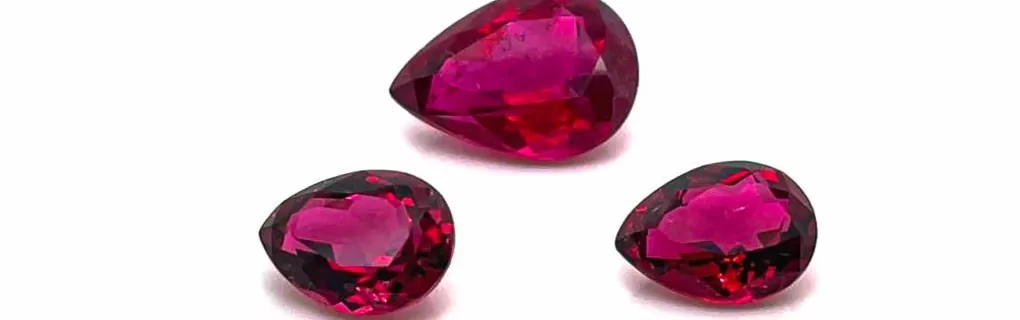
Ruby, unset, from the atelier.
The stone
No coloured gemstone commands a higher price per carat than a fine ruby. The intense red the Burmese have called “pigeon blood” for centuries is the benchmark — and one of the rarest hues in nature.
Rubies belong to the corundum family, as do sapphires. Chromium gives ruby its red. Quality depends on the balance of hue, saturation and tone, and on how lively the stone appears in the light.
Origins
- Burma (Mogok)
- The legendary source. Burmese rubies of pigeon-blood colour are the most expensive coloured gemstones there are, and set records at Christie's and Sotheby's with some regularity. The Mogok valley yields fewer top-quality stones every year.
- Mozambique
- The most important new source since the 2000s. Mozambican rubies show a strong, slightly darker red. The finest qualities approach Burmese stones at a fraction of the price — the sensible way to build a position.
- Tanzania, Madagascar, Thailand
- Further sources with good qualities. Thai rubies are often darker, Tanzanian ones usually smaller. For investment, Burma and Mozambique remain the first choice.
Ruby as an investment
Top-quality rubies are among the coloured stones whose prices have moved most clearly upward over the past two decades — that is my observation from the trade, not a listed index. An average annual return cannot honestly be stated for individual stones.
On 8 June 2023 the “Estrela de Fura”, an untreated ruby of 55.22 carats from Montepuez in Mozambique, sold at Sotheby's New York for USD 34.8 million — the highest price ever paid for a coloured gemstone (source: SSEF). A record describes that one stone, not the performance of rubies in general.

- The highest price per carat of any coloured gemstone
- The strongest demand on the international auction market
- Burmese rubies above 3 carats have become extremely scarce
- Mozambique offers the more accessible entry — and since the Estrela de Fura is recognised at the very top as well
- Deep cultural significance in Asia keeps demand high
- “Pigeon blood” is recognised as a quality standard worldwide
Quality criteria
- Colour
- The decisive factor. Pigeon blood — an intense red with a slight blue cast and strong fluorescence — commands the highest prices.
- Origin
- Burma (Mogok) is the reference, Mozambique the strongest alternative. Origin must be documented on the certificate.
- Clarity
- Rubies are almost never flawless. Fine silk inclusions of rutile needles can even raise the value where they produce a velvety glow.
- Treatment
- Unheated rubies are rare and sell for a multiple of treated stones. Heating is common and must be declared. Lead-glass filled stones are unsuitable for investment.
- Size
- Prices rise exponentially above 2 carats. Above 5 carats unheated, USD 50,000 to 200,000 per carat is not unusual.
- Certificate
- Mandatory: GIA, SSEF, Gübelin or GRS — always stating origin and treatment status.
The information on this page is provided for information purposes only and does not constitute investment advice. Past performance is not a reliable indicator of future results.

Personally
With a ruby, the red decides
A ruby is judged by its colour, and colour cannot be read from a certificate. I look at every stone myself, in daylight and under artificial light, and tell you honestly whether the red lives up to its name.
Burma or Mozambique, unheated or heated: all of it belongs on the table before you decide. If you would like to talk about a ruby, you can reach me directly.

Maximilian Hemmerle von HeckelFifth-generation jeweller · Munich
WhatsApp sayhi@mxhm.de +49 89 21 53 60 66
You are writing to a small, personal team, and usually to me directly.
Enquiry