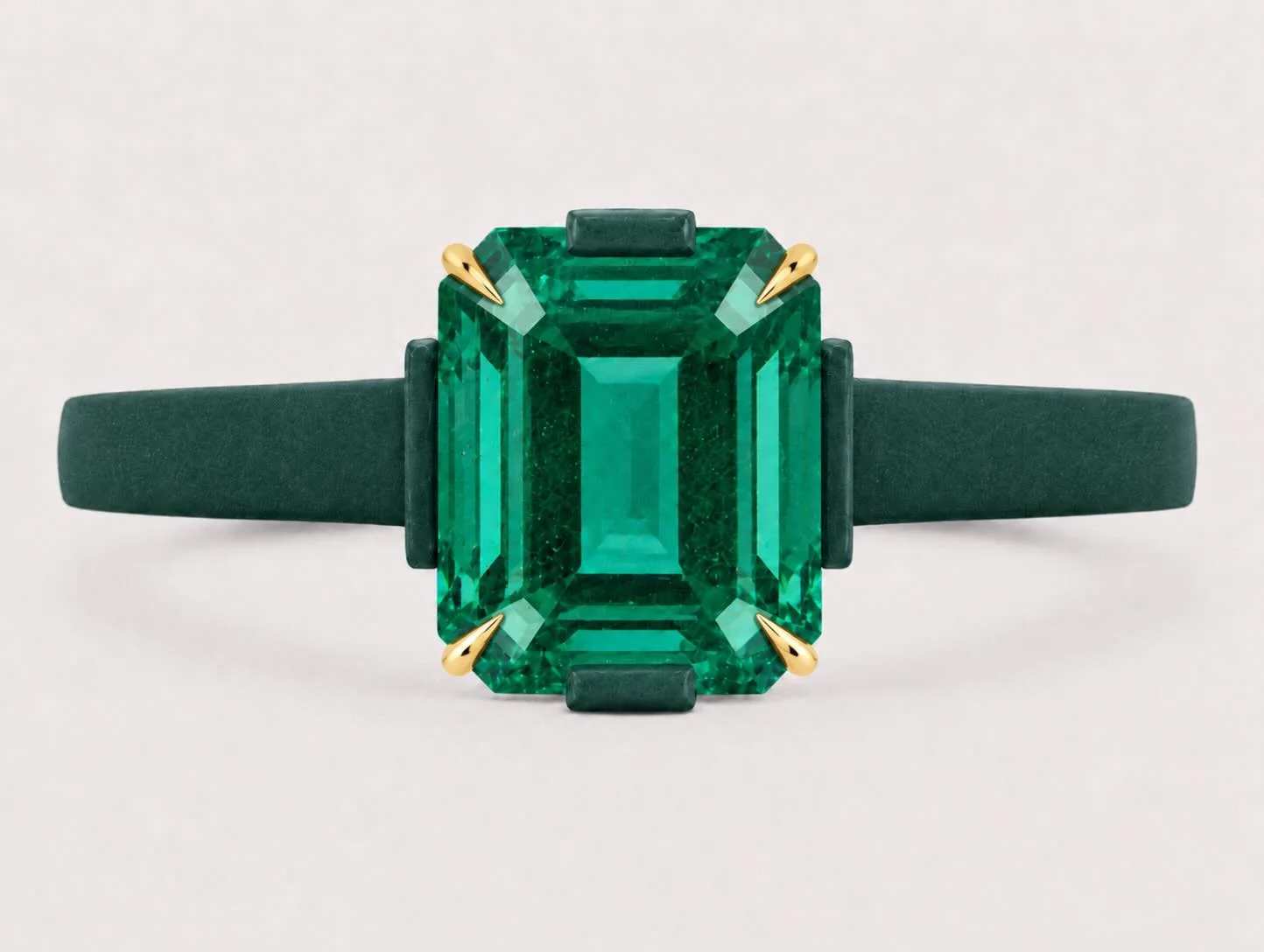
Emerald, unset, from the atelier.
The stone
Emeralds have held a particular fascination since antiquity. Cleopatra was obsessed with them; the Mughal emperors had them engraved with verses from the Koran. A fine emerald remains one of the most coveted stones in the world.
That characteristic green comes from traces of chromium and vanadium. The best examples show a deep, saturated green with a luminosity no other green stone reaches.
Origins
- Colombia (Muzo, Chivor, Coscuez)
- The reference for five hundred years. Colombian emeralds from the Muzo mine show the ideal warm green with a breath of blue. “Muzo green” is a fixed term among connoisseurs — and commands the highest prices.
- Zambia (Kagem)
- The most important African source. Zambian emeralds are often darker and slightly bluer than Colombian ones, but frequently cleaner and considerably less expensive. An excellent way in.
- Brazil, Ethiopia, Afghanistan
- Further sources capable of good qualities. For serious investment, Colombia and Zambia remain the preferred origins.
Emerald as an investment
The emerald market is calmer than that for ruby and Paraiba: steady demand for centuries, fewer jumps. Fine Colombian stones above 3 carats with little or no oil are so rare that they escape comparison with ordinary goods — and that is where the substance lies.
The 18.04-carat Colombian Rockefeller Emerald made USD 5.5 million at Christie's in 2017: over USD 300,000 per carat.

- Top-quality Colombian material is growing scarce; the best mines are near exhausted
- Demand has been historically stable for centuries
- High emotional and cultural value worldwide
- Zambia offers an attractive entry with solid appreciation
- Fine emeralds above 5 carats are exceptionally rare
- Lower volatility than rubies, with a steadier price curve
Quality criteria
- Colour
- The ideal green is intense, saturated and luminous — neither too dark nor too yellow. Muzo green is the benchmark.
- Origin
- Colombia commands the highest prices, followed by Zambia. Origin must be documented on the certificate.
- Clarity
- Emeralds are almost always included — it is part of their character, and the trade calls it the jardin. Eye-clean stones are extremely rare and valuable.
- Treatment
- Most emeralds are treated with oil or resin. “No oil” and “minor oil” sell for a multiple. For investment, aim for no oil to minor.
- Size
- Above 3 carats in fine quality, prices rise disproportionately. Colombian stones above 5 carats without oil are rarities.
- Certificate
- Mandatory: Gübelin, SSEF, GRS or GIA — with origin and oil classification.
The information on this page is provided for information purposes only and does not constitute investment advice. Past performance is not a reliable indicator of future results.

Personally
With an emerald, what counts is not obvious
Almost every emerald has inclusions, and almost every one is oiled. What matters is how much and with what. I look at every stone myself and tell you honestly whether its colour carries and whether it is worth its price.
Colombia or Zambia: each origin has its own green. If you would like to talk about an emerald, you can reach me directly.

Maximilian Hemmerle von HeckelFifth-generation jeweller · Munich
WhatsApp sayhi@mxhm.de +49 89 21 53 60 66
You are writing to a small, personal team, and usually to me directly.
Enquiry