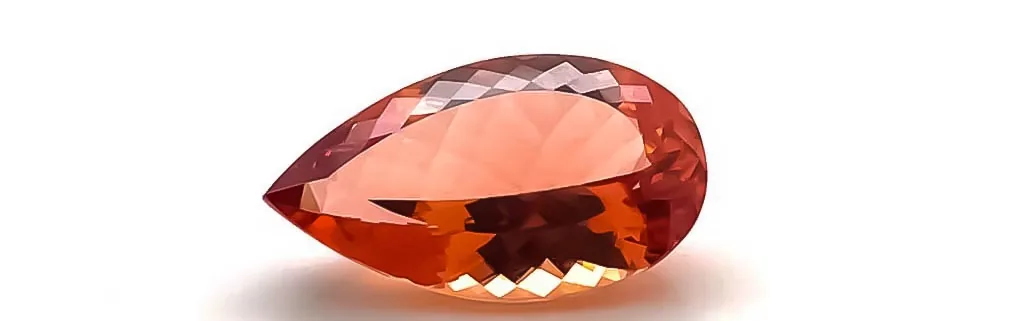
Imperial Topaz, unset, from the atelier.
The stone
When people think of topaz they think of an inexpensive blue stone. That is ordinary topaz. Imperial topaz is something else entirely — and one of the rarest gemstones in the world.
Its warm orange, shot through with pink and peach, is unique. The finest examples shift colour in the light in a way that recalls a sunset. And it is traded entirely untreated.
Origins
- Ouro Preto (Brazil)
- The historic gold-rush town in Minas Gerais is the only relevant source. The mines are small, worked by hand, and yield limited quantities. No industrial extraction, no large reserves in waiting.
- The colour range
- The most coveted colours run from warm sherry orange through salmon and peach to a rare, intense pink-orange — “imperial pink”, which commands the highest prices.
Imperial Topaz as an investment
Imperial topaz is a niche market: a single relevant source, small quantities, few comparable pieces at auction. That makes it interesting for collectors and unsuitable for promises of return — whoever buys it buys rarity and colour, not a curve.

- Only one relevant source worldwide
- No industrial mining; annual production is limited
- Still moderate prices compared with the great four
- Entirely untreated — no treatment discussion at all
- Growing recognition at international auction
- Its low profile is the opportunity
Quality criteria
- Colour
- Intense orange-pink through to imperial pink commands the highest prices. Pale yellow-orange is worth considerably less; saturation makes the difference.
- Origin
- Practically always Ouro Preto. Other origins are extremely rare and not relevant for investment.
- Clarity
- Imperial topaz is often very clean. Eye-clean is the standard; included stones are of little interest for investment.
- Treatment
- A significant advantage: imperial topaz is almost never treated. Irradiation and heating do not occur in genuine material.
- Size
- Above 5 carats in fine colour it becomes interesting. Stones above 10 carats in imperial pink are decidedly rare.
- Certificate
- GIA, Gübelin or SSEF. An origin report is advisable, even though the source is effectively unambiguous.
The information on this page is provided for information purposes only and does not constitute investment advice. Past performance is not a reliable indicator of future results.

Personally
Not every orange topaz is imperial
The name is given generously. What decides is the pink within the orange and the change of colour in the light. I look at every stone myself and tell you honestly whether it deserves the name.
If you would like to talk about an imperial topaz, you can reach me directly.

Maximilian Hemmerle von HeckelFifth-generation jeweller · Munich
WhatsApp sayhi@mxhm.de +49 89 21 53 60 66
You are writing to a small, personal team, and usually to me directly.
Enquiry