Bespoke
How your piece is made
It begins with a conversation. At my atelier, at your home, at a fair – wherever suits you. You tell me what the piece is meant for. I listen.


Six stations
- One
The conversation
What is the piece for, who wears it, what should it say. I ask about the occasion, the person, sometimes the family. Everything else grows from this – and by the end we both know whether a Création is the right way. The conversation is without obligation.
- Two
The Création
With your commission the work begins. I am not the go-between for you, a stone dealer and a workbench – I answer for the whole, the way an architect answers for the house and not for the bricklayers. The Création fee is credited in full against the making. I tell you the amount in the first conversation; it becomes binding only with your commission. Should you decide against having the piece made, the design and the research are yours to keep.
- Three
The stone
Sometimes it is already at the atelier. Sometimes I have to find it on the other side of the world – Hong Kong, Bangkok, Colombo, occasionally at the mine. I buy every stone myself, certified, with documented origin.
- Four
The design
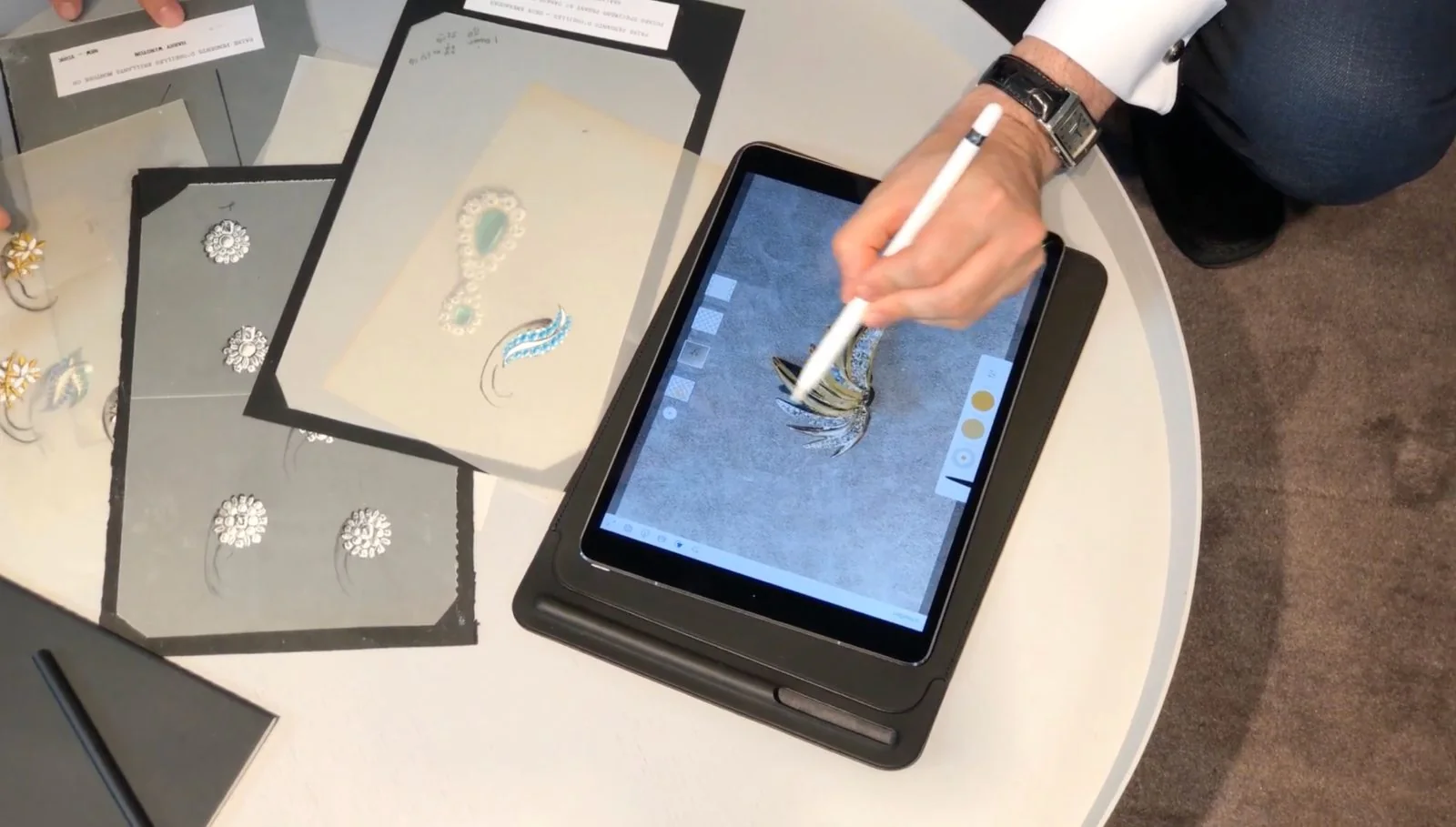
You receive sketches and mood boards. We exchange, refine, change – until you say: that is it.
- Five
The specialists
Every piece is made by hand. Setter, goldsmith, cutter, engraver: for each piece I choose the specialists it needs and direct them. Precise, without compromise. No piece leaves the atelier that I have not checked myself.
- Six
The handover
In the right moment, in the right setting. That is part of the piece.
What is fast, and what takes time
Diamond studs, an eternity ring, a tennis bracelet: the result can be in your hands within days. Even there, every detail counts – the right setting, the proportions, the way it feels. That is knowledge from five generations.
A necklace around one stone that I first have to find takes months. Both are right. The difference is only the road, never the standard.
From the atelier
Twenty pieces, twenty decisions
Each of them came into being for one person. The stone comes first; the second sentence is the decision that made the piece this piece.

Painite, over one carat – one of the rarest minerals, in gold and platinum with champagne diamonds.
The setting had to protect the stone on the hand without hiding it.

A large oval smoky quartz, above it purple garnets in 18 kt rose gold.
Instead of a chain, a hand-plaited band of dark brown nappa leather.

Titanium and 18 kt gold, a hand-cut cabochon at the centre.
After a 1930s design by my grandfather René Sim Lacaze, rethought: the titanium rings keep the pair light.

Titanium, white gold, rock crystal and baguette diamonds.
The crystal carries the sun, the baguettes the rays – and titanium keeps the weight down.

Rock crystal, brilliants, 18 kt white gold.
I had the crystals cut and engraved after an old path pattern in one of Germany's finest lapidaries.

The same form twice: once made in 18 kt rose gold, once cut from an amethyst.
Metal and stone carry the same line – the only question is which colour belongs to you.

Diamonds from the client's inheritance, one central diamond, a geometric setting.
Matt platinum, so the old stones stay in front and the metal steps back.

Old European cut diamond with two baguettes in platinum.
An old cut for a ring worn every day – for very good friends.

Old European cut of 3.28 carats, around a hundred years old, in its equally old Art Deco setting.
Stone and setting had been parted; I restored both carefully and brought them back together.

Fancy intense yellow diamond, cushion cut, baguette diamonds.
The wish was to carry the sun along. The setting is inspired by Art Deco.

Emerald cut diamonds, white gold.
The stones were cut to match one another; cross and chain are sandblasted and blackened so the diamonds stand all the brighter.

Mandarin garnet, green tourmalines, rose gold.
The gold tone is matched to the stone; the tourmalines set a deliberately restrained accent.

Tourmalines, sapphires and citrines in rose gold.
The second pair for the same wearer – the first in red, this one in green and orange.

Blue topaz in platinum.
The stone first: found, then the setting built around it.

A flexible rose gold cuff with enamel, two natural zircons, diamonds.
After old Italian techniques – the two zircons are deliberately not quite alike.

Blossoms in titanium with 18 kt gold and fine sapphires.
After a design by my grandfather from around 1930, originally a brooch – revived in titanium and thought in several colours: raspberry garnet, tsavorite, brown and white diamonds.

Blackened platinum, an oval red-rose tourmaline, diamonds.
The dark metal lets the colour of the stone speak alone; the diamonds sit as a wreath in the grained surface.

Burnished bronze, a deep green tourmaline in a rectangular cut, flanking stones.
Ring no. 3 of a series of one-offs: sculptural in build, clear in line, raw in surface – the bronze deliberately dark, almost archaic.

Santa Maria Africana aquamarine, above it a sapphire cabochon, sapphires in the bail – blackened gold.
The blackened metal holds back; the pendant is built from the stone outward, the bail carries the sapphires like a ring.

Earrings that can also be worn as clips on a dress – white, yellow and rose gold, bronze, champagne diamonds.
The drawing before the piece existed: that is how every commission begins with me.
Personally
Every piece begins with a conversation
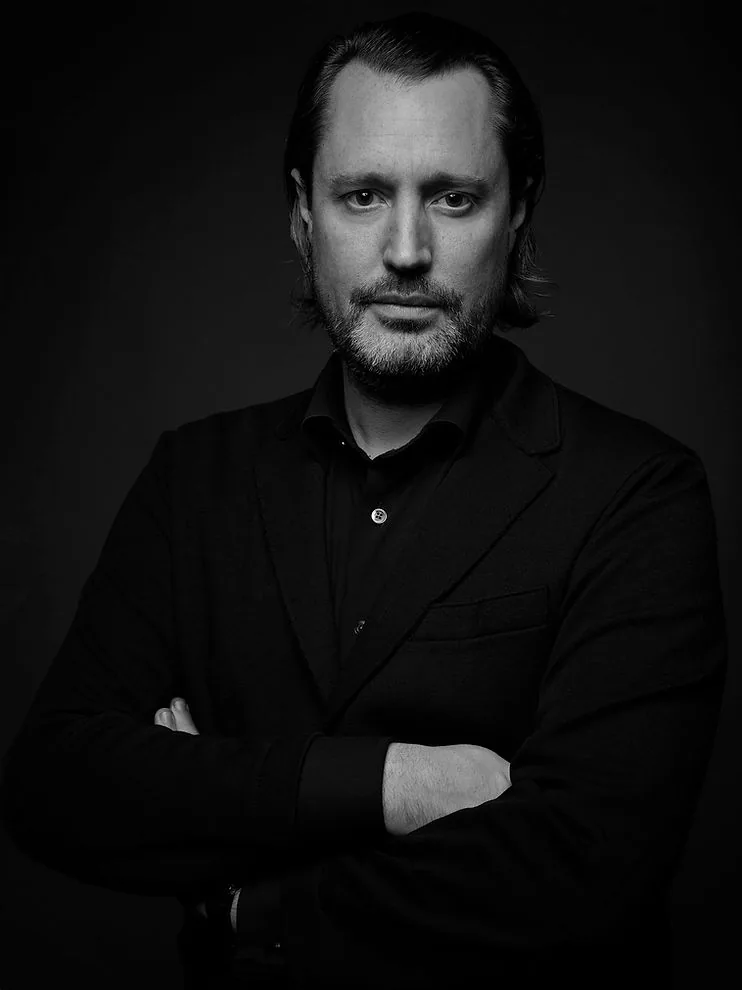
I choose the stone, design the piece and direct the specialists who make it. What you bring is the occasion, an idea, or simply a sense of what is missing.
If you would like to talk something through first, you can reach me directly.

Maximilian Hemmerle von HeckelFifth-generation jeweller · Munich
WhatsApp sayhi@mxhm.de +49 89 21 53 60 66
You are writing to a small, personal team, and usually to me directly.
Enquiry