Diamond studs
The perfect
diamond stud
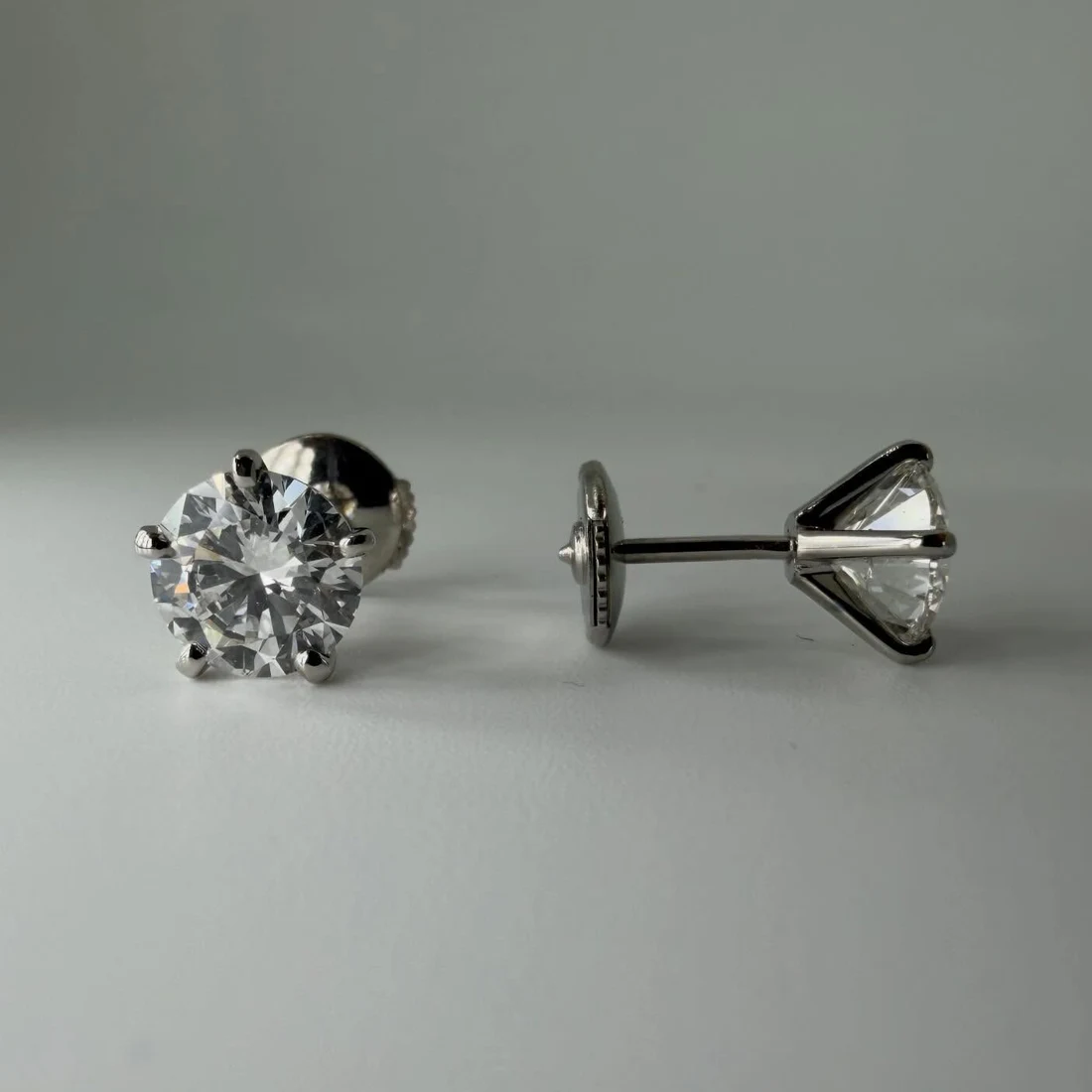
Five prongs, Y architecture, French clutch. This is how reduction, comfort and security balance out. I have built a great many. This is the result.
The arithmetic
More stone, less metal
A stud has one job: to show a stone. Everything the metal does beyond that is taken from the diamond. The setting is therefore a calculation of visible stone, quiet of form, comfort and security.
Six prongs are the standard of the trade: safe, but they cover more girdle than necessary. Four prongs are the other extreme, open and reduced, but the tilting moment grows with the stone. Five prongs are the point where the curves cross.
From one and a half carats I therefore build a round brilliant with five prongs in Y architecture and a French clutch.
1.5 carats each, round brilliant, platinum 950.
The Y architecture
From the front you see five slender prongs. In profile they open upward and draw together beneath the stone. That Y carries the diamond a little higher, lets light reach the pavilion from the side, and needs less metal than any setting that encloses the stone.
On the ear the stone reads larger as a result, and it sits upright.

The closure
The French clutch
An ordinary push-back presses on a single point and lets heavier stones tip forward. The French clutch lays a broad, gently domed surface against the lobe and distributes the weight.
- A broad bearing surface instead of a pressure point — comfortable after twelve hours
- The stone stands upright
- Secured by engagement, not merely clamped
- Platinum 950 or 18ct gold, matched to the setting
The settings compared
Four, five, six — or none at all
Four pieces from my atelier, face-up. Watch how much stone is left in each case.


The metals
Platinum, yellow gold, rose gold
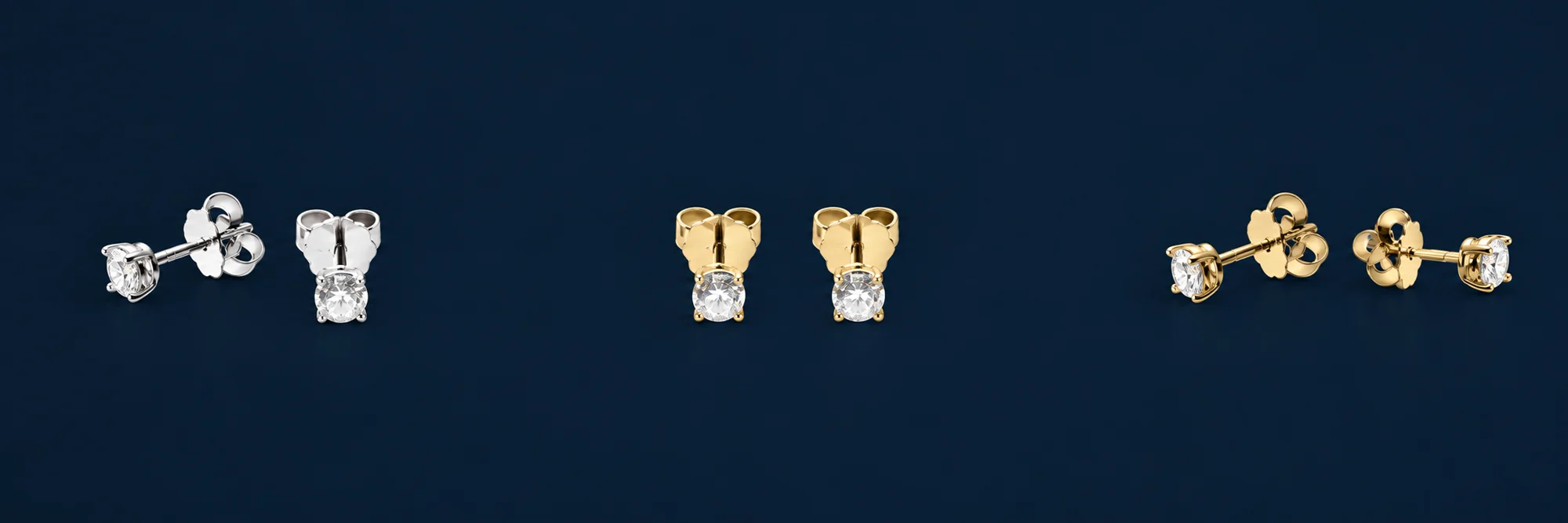
Platinum 950 or 18 kt white gold — indistinguishable in a photograph —, 18 kt yellow gold, 18 kt rose gold. The price is the same in every metal.
The sizes
When four prongs, and when five
The five-prong construction is the answer for large stones. A stud under a carat has too little mass to tip; there, less metal is the better choice.
For orientation
Your pair

Carat per stone
Quality
Metal
- Setting
- Five prongs, Y architecture
- Closure
- French clutch
- Total weight
- 3.00 ct
- Diameter
- 7.44 mm
- Certificate
- GIA, per stone
Including German VAT. Calculated on the day; I select the pair myself. The image shows a genuine MXHM stud in the five-prong setting on a model, to scale with the size you choose.
Price table
Every size at a glance
| Carat per stone | Total | Diameter | Prongs | Wesselton SI | Top Wesselton VS | River VVS |
|---|---|---|---|---|---|---|
| 0.33 ct | 0.66 ct | 4.49 mm | 4 | 1,600 € | 2,300 € | 2,700 € |
| 0.50 ct | 1.00 ct | 5.16 mm | 4 | 2,000 € | 3,400 € | 4,500 € |
| 0.75 ct | 1.50 ct | 5.91 mm | 4 | 3,200 € | 5,900 € | 7,900 € |
| 0.80 ct | 1.60 ct | 6.03 mm | 4 | 3,600 € | 6,600 € | 9,600 € |
| 1.00 ct | 2.00 ct | 6.50 mm | 4 | 6,200 € | 12,000 € | 19,500 € |
| 1.50 ct | 3.00 ct | 7.44 mm | 5 | 14,500 € | 28,500 € | 46,000 € |
| 2.00 ct | 4.00 ct | 8.19 mm | 5 | 33,000 € | 59,500 € | 97,500 € |
| 3.00 ct | 6.00 ct | 9.37 mm | 5 | 81,000 € | 148,500 € | 236,000 € |
| 4.00 ct | 8.00 ct | 10.32 mm | 5 | 158,000 € | 261,000 € | 413,500 € |
| 5.00 ct | 10.00 ct | 11.11 mm | 5 | 265,500 € | 371,500 € | 735,500 € |
Prices per pair, including German VAT. Handover is usually in person; insured shipping can be arranged, with the cost stated in the quote. Platinum 950 or 18ct gold. Diamond prices move daily; a binding quote is calculated on the day, and I select the pair myself. Grades to GIA: Wesselton SI = H · SI1–SI2, Top Wesselton VS = F–G · VS1–VS2, River VVS = D–E · VVS1–VVS2.
Frequent questions
What I get asked about studs
- Why five prongs and not six?
- Every prong costs visible stone. Five hold just as securely as six, show more diamond and read more quietly.
- And why not four?
- The tilting moment grows with the stone: from about one and a half carats a four-prong stud leans forward in the lobe. Below that it is the right choice.
- What is the Y architecture?
- The prongs open upward and draw together beneath the stone. The Y carries the diamond a little higher, lets light reach the pavilion from the side, and uses less metal.
- What is a French clutch?
- A closure with a broad, gently domed back plate that rests against the lobe and holds the stud upright.
- Which size suits me?
- One carat measures about 6.5 millimetres, one and a half carats 7.4, two carats 8.2. Best is to try two sizes side by side in the atelier.
- Do I get a certificate?
- Yes: an independent GIA certificate from half a carat per stone upward. That both stones match in colour, clarity and cut I check on top — two certificates do not yet make a pair.
- Can existing stones be reset?
- Gladly. Inherited stones often feel entirely different in a five-prong setting.
The pair
Two stones that belong together
With studs you are buying two diamonds that nobody should be able to tell apart. Two stones with identical certificates can still look different, because life in a stone cannot be put into letters.
I choose the pairs myself and lay them side by side before setting. If you are looking for a size between two steps, or a pair for a particular occasion, you can reach me directly.

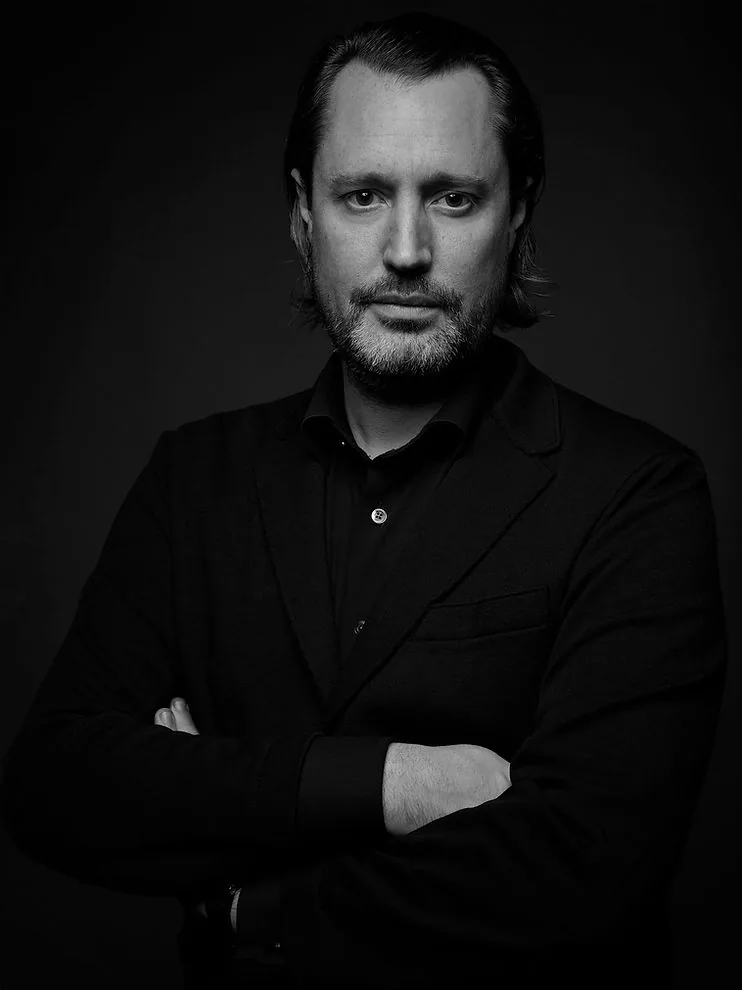
Maximilian Hemmerle von HeckelFifth-generation jeweller · Munich
WhatsApp sayhi@mxhm.de +49 89 21 53 60 66
You are writing to a small, personal team, and usually to me directly.
Enquiry