Paraiba Tourmaline
The rarest coloured gemstone on earth.
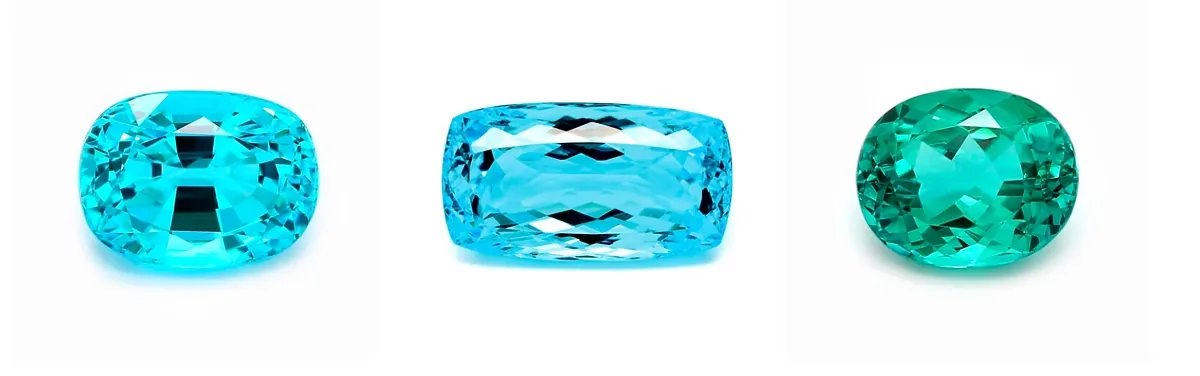
Paraiba Tourmaline, unset, from the atelier.
The stone
No other gemstone glows like a Paraiba. The characteristic neon blue to neon green, caused by traces of copper and manganese, has no equal in nature. Since their discovery in 1989 in the Brazilian state of Paraíba these stones have been among the most coveted in the world.
Where rubies, sapphires and emeralds have been known for millennia, the Paraiba story is barely thirty-five years old. Deposits are extremely limited. Every stone is a geological one-off.
Origins
- Brazil (Paraíba, Rio Grande do Norte)
- The original. Brazilian Paraibas show the most intense neon blue and command the highest prices worldwide. The deposits are all but exhausted, and new finds of this quality are considered unlikely.
- Mozambique
- A second source since the early 2000s. The stones are often larger and the colours a little less intense — considerably more accessible in price, and still appreciating strongly.
Paraiba Tourmaline as an investment
No coloured gemstone has shown a steeper price development since its discovery than the Brazilian Paraiba: stones that cost a few thousand dollars a carat in the 1990s now trade at five and six figures a carat in top quality. That is market observation, not a formula for returns.
On 10 December 2025 a Tiffany & Co. necklace with a Brazilian Paraiba of 13.54 carats sold at Christie's New York for USD 4.223 million — an auction record for a Paraiba. The price is for the whole jewel, with diamonds and signature, not for the loose stone; a per-carat figure can only be approximated from it.
- Extremely limited deposits with no new sources in sight
- Rising demand on the international auction market
- Brazilian stones above 3 carats are practically unobtainable
- Instantly recognisable: the colour is unmistakable
- Mozambique offers an attractive entry with above-average potential
- The youngest of the great gemstones — market awareness is still growing
Quality criteria
- Colour
- The decisive criterion. Electric blue and neon blue command the highest prices; stones that are too dark or too pale lose value sharply.
- Origin
- Brazil against Mozambique makes a substantial difference, often a factor of three to five. Origin is documented on the certificate.
- Size
- Brazilian Paraibas above 2 carats are extremely rare and exponentially more expensive. Mozambique also yields larger stones.
- Clarity
- Slight inclusions are typical and accepted. Eye-clean stones are rare and priced at a premium.
- Treatment
- Most Paraibas are lightly heated, which is standard and accepted. Unheated stones are the exception.
- Certificate
- Mandatory: GIA, SSEF, Gübelin or GRS — always with origin and copper analysis.
The information on this page is provided for information purposes only and does not constitute investment advice. Past performance is not a reliable indicator of future results.

Personally
A glow you cannot mistake
With a Paraíba, luminosity decides, and origin is a chapter of its own. A certificate confirming copper and origin is part of it for me before I show you a stone.
Brazil or Mozambique, neon blue or neon green: I tell you honestly what a stone is worth. If you would like to talk about a Paraíba, you can reach me directly.

Maximilian Hemmerle von HeckelFifth-generation jeweller · Munich
WhatsApp sayhi@mxhm.de +49 89 21 53 60 66
You are writing to a small, personal team, and usually to me directly.
Enquiry