
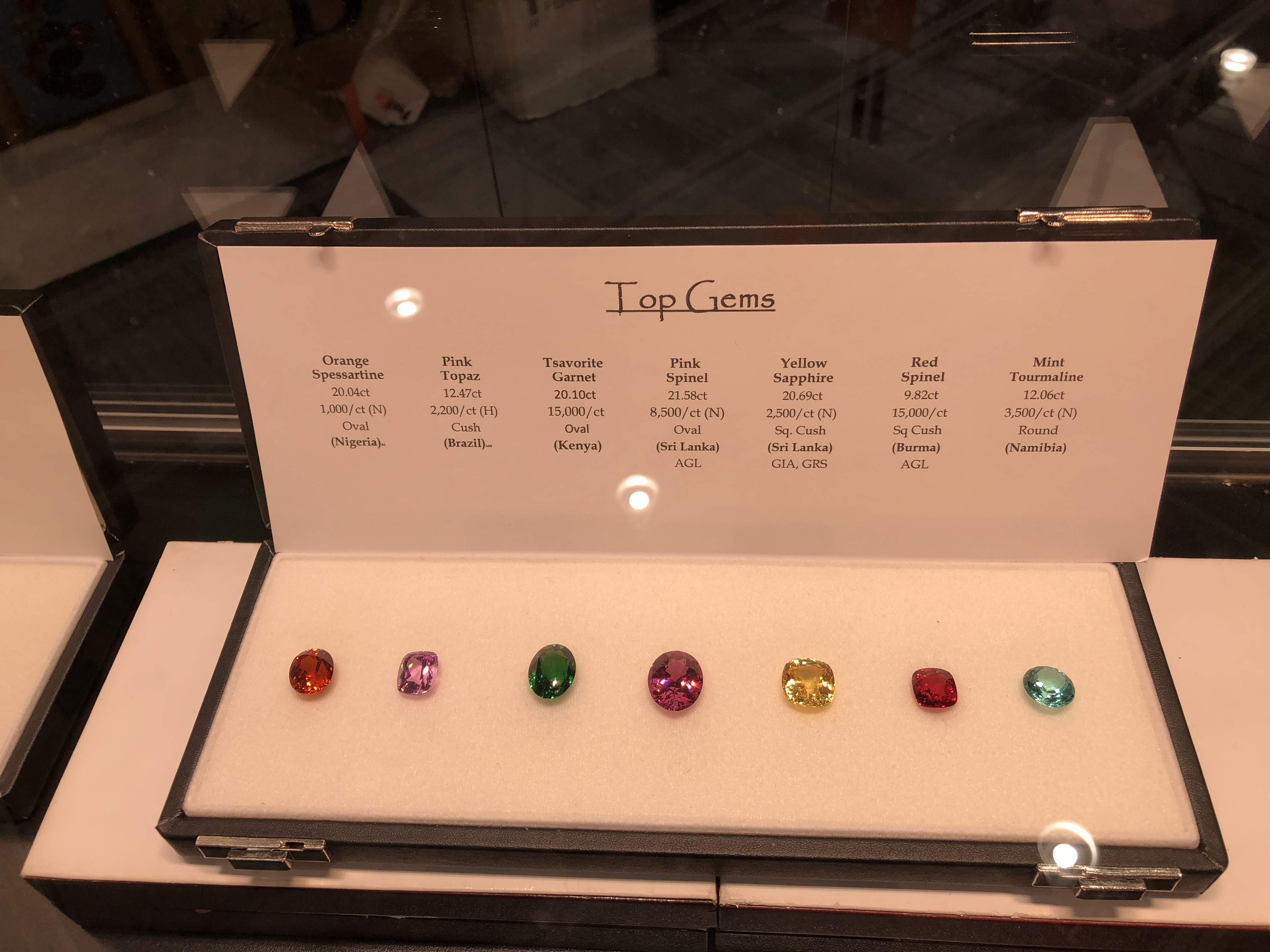
There is a moment in every auction when the room falls silent: when a Kashmir sapphire lies under the loupe and the bids run far beyond the estimate. I have seen it happen more than once. That is the light in which real gemstones shine.
My grandmother's treasure chamber
My grandmother was not a collector in the classical sense. She was a woman who allowed herself beautiful things when they pleased her. Over five decades, a portfolio accumulated in her safes: rubies from Burma, emeralds from Colombia, spinels, one or two extraordinary sapphires.
As she built up her collection, she was not thinking about investment returns. She was thinking about ownership. About beauty. About something tangible that one could hold in one's hand.
What she gathered over the decades is worth many times what she paid for it today – not dramatically, but steadily, through the financial crisis of 2008 and every bout of market turbulence since. I deliberately give no figures: it is a family collection, not a balance sheet, and for coloured gemstones there is no index that could prove a return.
The reason was simple: real gemstones are scarce. Their scarcity is real, geological, not artificially constructed. And their beauty cannot be discounted.
Why gemstones, not gold?
Gold is the reference against which other tangible assets are measured, and it can be held physically. That is a good reason to own it.
A gemstone brings individual characteristics in addition: colour, cut, origin and the possibility of wearing it as jewellery. Every ounce of gold is like the next; no stone is like another. These differences are what make its appeal – and what make its valuation more demanding.
And as for the pure numbers: for Burma rubies, Kashmir sapphires and Paraiba tourmalines of the finest quality there is no index, only auction results and dealer prices. Both show the same direction over the past 25 years: clearly upwards, steepest of all for Paraiba. Exactly how far depends on the individual stone, and that is the difference from gold.
Gold? Gold has also risen strongly over the same period, but every ounce equally. A ruby has not.
Four reasons why fine gemstones hold their value
- Limited supply. A ruby deposit runs dry. A mine is exhausted. The stones being dug up today are not the same as those dug up 40 years ago. A farm can be expanded as demand requires. A mine cannot. Scarcity is real.
- Cultural anchor. Gemstones have been part of human history for 5,000 years. A diamond is not valuable only because diamonds are rare; it is valuable because we all collectively believe that it is. That kind of consensus is powerful. It is more stable than algorithms.
- Wearability. A work of art hangs on the wall. A gemstone is worn. That means the emotional anchor is not theoretical; it is concrete, daily, tangible. People hold on to assets they love for longer. That stabilises prices.
- Independence from infrastructure. A gemstone sits in your safe. It is not administered, not held in a custody account, not a digital entry. That does not protect against market cycles – but it makes ownership independent of the systems that other assets need in order to be tradeable at all.
What to look out for
But not every gemstone is an investment stone. The market distinguishes brutally between investment grade and decorative gemstone.
A beautiful ruby is not the same as an investment ruby. An investment ruby must satisfy:
The four pillars
Origin. A Burma ruby is not the same as a Thai ruby. Origin is what the appellation is to wine: the decisive context. Colombian emeralds are the benchmark. Ceylon sapphires are the benchmark. Everything else is a variant.
Treatment. An untreated ruby can be worth many times a treated one. This is where independent certificates are needed: GRS, GIA, SSEF.
Quality. Only the very top qualities come into consideration for such a development at all. A mediocre ruby is a mediocre ruby. It does not improve with time.
Personal expertise. The gemstone market is opaque. There is no Bloomberg terminal for sapphires. What there is, is personal relationships, long-standing expertise and a proper nose for where real quality is hiding.
A personal reckoning
I am a jeweller. My grandmother was a collector. And my conclusion is this:
In an age in which most assets are abstracted – digital entries, cryptocurrencies, funds – a gemstone has a quality that is precious: presence.
It is there. It needs no server, no intermediary, no technical infrastructure. It needs only you and a safe.
And when it comes to uniting beauty and substance, when it comes to owning something that one wears, that one loves and that is at the same time an asset, there are few options as elegant as a real gemstone.
If you are considering gemstones as a serious part of a lasting estate, or if you simply wish to understand what to look out for, let us talk about it.
Not as a sale and not as investment advice. As a passing-on of knowledge. Book a consultation.