
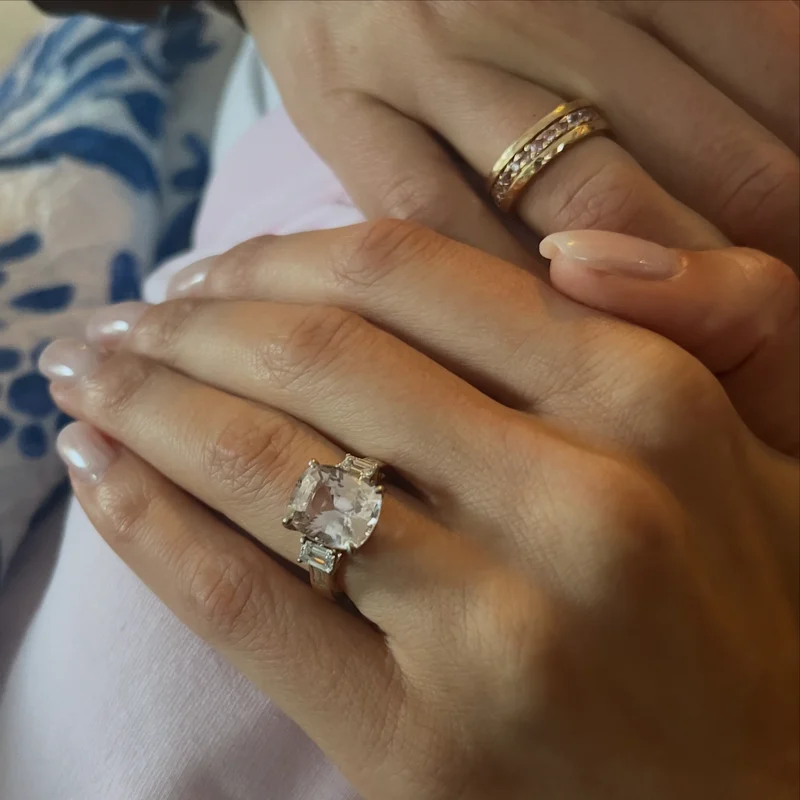
In Germany and Austria, the engagement ring is traditionally worn on the ring finger of the left hand. At the wedding, in the classic version, it moves to the right, or it stays on the left and the wedding ring joins it on the right.
The short answer
In Switzerland, same language and a shared border, the wedding ring by contrast mostly stays on the left. Likewise in the USA, the United Kingdom, France and Italy.
In Brazil, both partners wear their rings on the right at first and switch to the left at the wedding. In India, the left hand was traditionally taboo.
Which means: there is no right hand. There is only the hand that happens to be customary where you live.
This insight is not an evasion but a release. Anyone who understands how arbitrarily the rule came about stops worrying about getting it wrong. And can turn to the question that actually decides the next thirty years. It comes further down.
Engagement ring: which hand is customary in Germany?
The common practice in the German-speaking world is quickly told. Before the wedding, the recipient wears the engagement ring on the left ring finger. With the wedding there are four common paths, and all four are equally usual:
First. The engagement ring moves to the right hand, the wedding ring joins it, both on the right.
Second. The engagement ring stays on the left, the wedding ring is worn on the right. Two hands, two meanings.
Third. The engagement ring is taken off and kept for special occasions; only the wedding ring is worn, on the right.
Fourth. Both rings are stacked together on one hand. This version has grown markedly over the past ten years.
In Austria it is largely identical.
And then there is Switzerland. Same language, shared border, in many respects the same culture, and there the wedding ring is very predominantly worn on the left, not the right. In current practice the engagement ring also mostly stays on the left; the older rule, by which it was worn on the right and moved to the left at the wedding, is still known but in retreat. The reason one hears in Switzerland, incidentally, is rarely the heart and more often something practical: most people are right-handed, and on the left a ring stays beautiful for longer.
Anyone now thinking that there is no system to this is right. Between Munich and Zurich lie 300 kilometres and no language border, and still the ring changes hands.
Why the ring finger at all? The story of the vena amoris
The explanation you read in almost every guide goes like this: from the ring finger of the left hand a vein is said to run directly to the heart, the vena amoris, the vein of love. Hence the ring, hence the left.
The story is old and it is beautiful. Only it is not anatomically true. No such vein exists. The blood supply to the fingers does not differ between the left and right hand in any way that has anything to do with the heart.
More interesting is where the idea comes from. The Roman author Aulus Gellius reports in the Attic Nights an Egyptian account he says he found in Apion: in the fourth finger runs a fine connection to the heart. In Gellius, however, it is a nervus, a sinew or a nerve, not a vein. Macrobius, too, later describes the connection as a nerve. Only over the centuries did the nerve become a vein.
The story took its fixed form in 1686, when Henry Swinburne's A Treatise of Spousals, a legal work on the promise of marriage, was published posthumously in England. There stands the sentence that sealed the matter: just as the betrothed give each other their hand, so they should also give each other the heart, to which that vein leads. A canon lawyer, then, turned an ancient anecdote into a justification, and the justification has survived because it feels good.
I do not tell this to take anything away from anyone. I tell it because something useful follows from it: if the justification is a misunderstanding, then the rule is not a rule either. It is convention, and one may know conventions and still decide otherwise.
Why left and right parted ways in the first place
The divide between the left and right hand runs conspicuously along confessional lines in Europe. The common explanation: in the Reformation era, the right hand prevailed in Protestant regions, partly as a visible distinction from Catholic practice. In Christian symbolism the right hand is the hand of the oath, of blessing and of law; it suits an understanding of marriage that sees the bond as a public, legally binding pledge. The left hand is the hand of closeness to the heart.
That this alignment later blurred (today in Germany, Catholics and Protestants alike wear the wedding ring on the right) makes it no less revealing. It shows that the question was never one of aesthetics but always one of belonging. One wore the ring where one's own group wore it. And because belonging changes, so does the hand.
A postscript on the German-speaking world that is often left out: the engagement ring with a stone, as we know it, has a fairly precise point of origin here. In 1477, Archduke Maximilian I of Habsburg had a ring set with diamonds made for Mary of Burgundy, the first documented diamond engagement ring. The tradition around which millions of searches revolve today begins with a single commission.
Engagement ring and wedding ring around the world: which hand where?
The following overview summarises the widespread traditions. Important: these are tendencies, not rules. In almost every one of these countries you will find people who do it differently: by region, by confession, or simply because they prefer it that way.
| Country / Region | Engagement ring | Wedding ring | Note |
|---|---|---|---|
| Germany | left | right | switch at the wedding, four common variants |
| Austria | left | right | as in Germany |
| Switzerland | mostly left | left | unlike Germany: both rings predominantly on the left. Older rule (engagement ring on the right, switch at the wedding) still known but declining |
| USA | left | left | both rings on one hand, stacking widespread |
| United Kingdom | left | left | as in the USA |
| France | left | left | |
| Italy | left | left | |
| Sweden | left | left | |
| Poland | left | right | |
| Russia | left | right | |
| Norway | left | right | |
| Bulgaria | not customary | right | |
| Greece | not customary | right | Orthodox tradition |
| Portugal | not customary | right | |
| Spain | varies | mostly right | Catalonia differs, strong regional variation |
| Netherlands | varies | varies | historically divided by confession, mixed today |
| Turkey | right | right | sometimes a switch after the wedding |
| Brazil | right (both partners) | left | plain bands, switch at the vows |
| India | right | right | left hand traditionally considered unclean |
| Chile | right (both partners) | left | similar to Brazil |
If you look at this table for a minute, one thing stands out: the line between left and right runs straight across Europe, not along any comprehensible logic. Germany right, France left. Poland right, Sweden left. Germany and Switzerland share a language and a border, and do it exactly the other way round.
What this means in practice
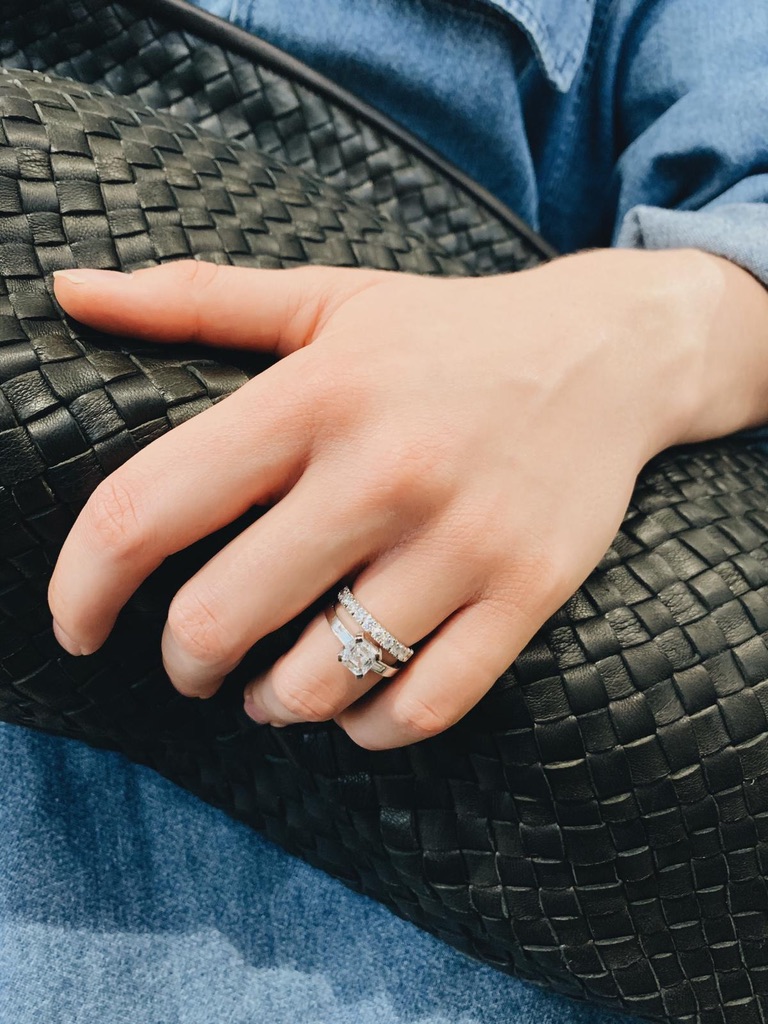
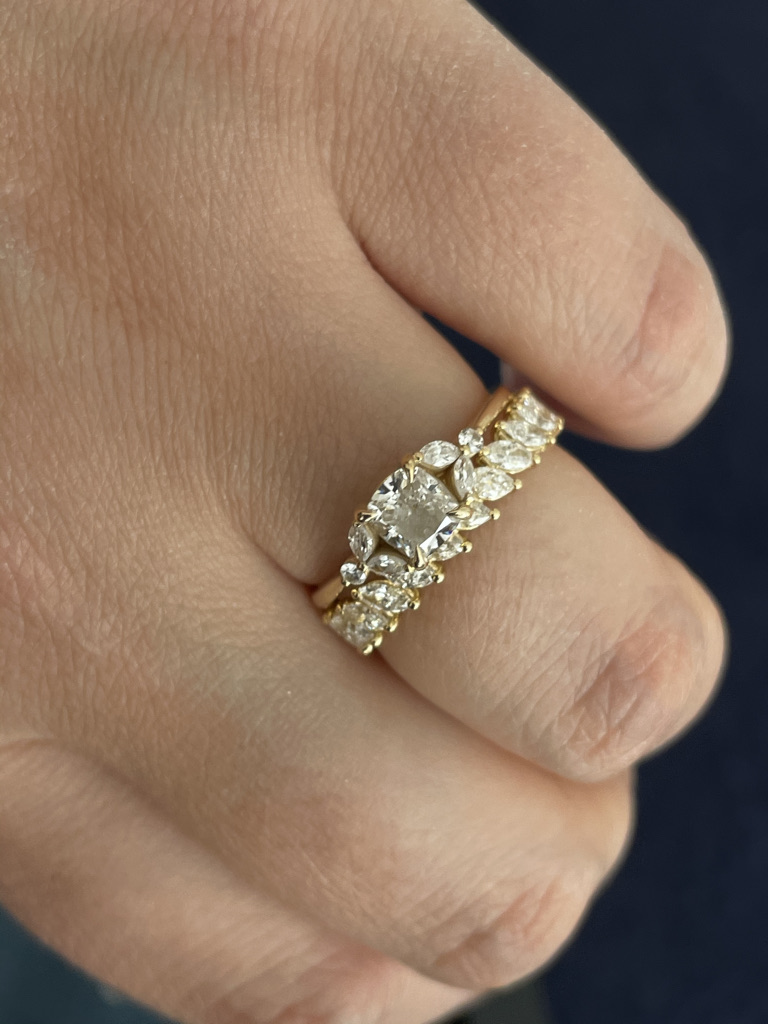
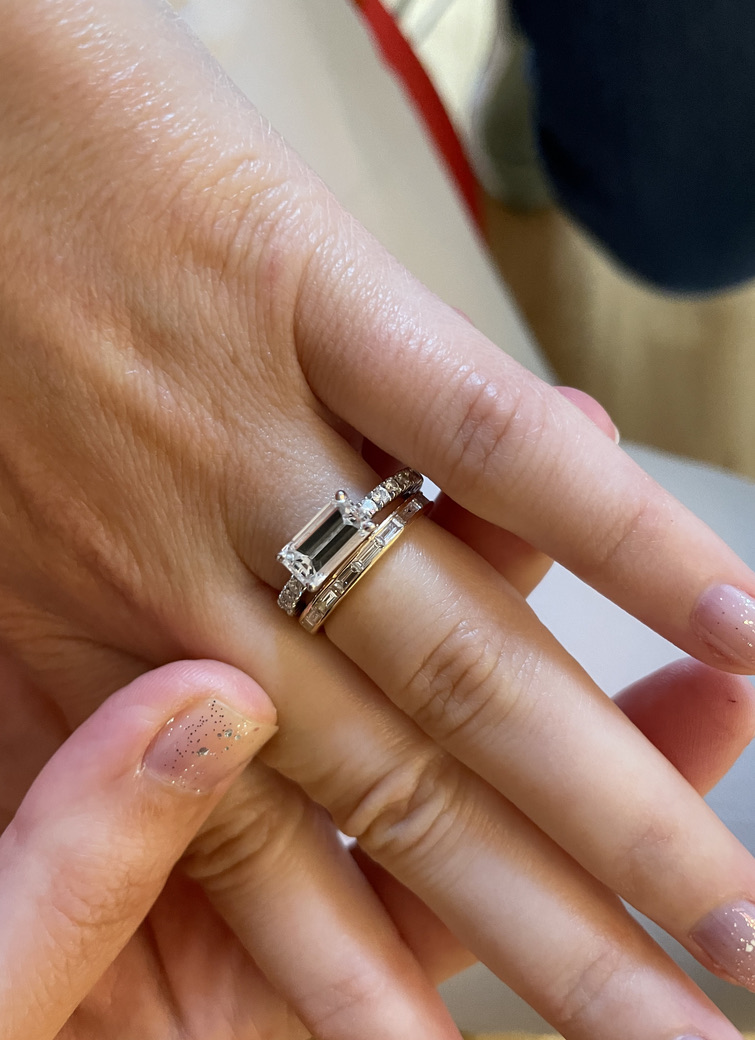
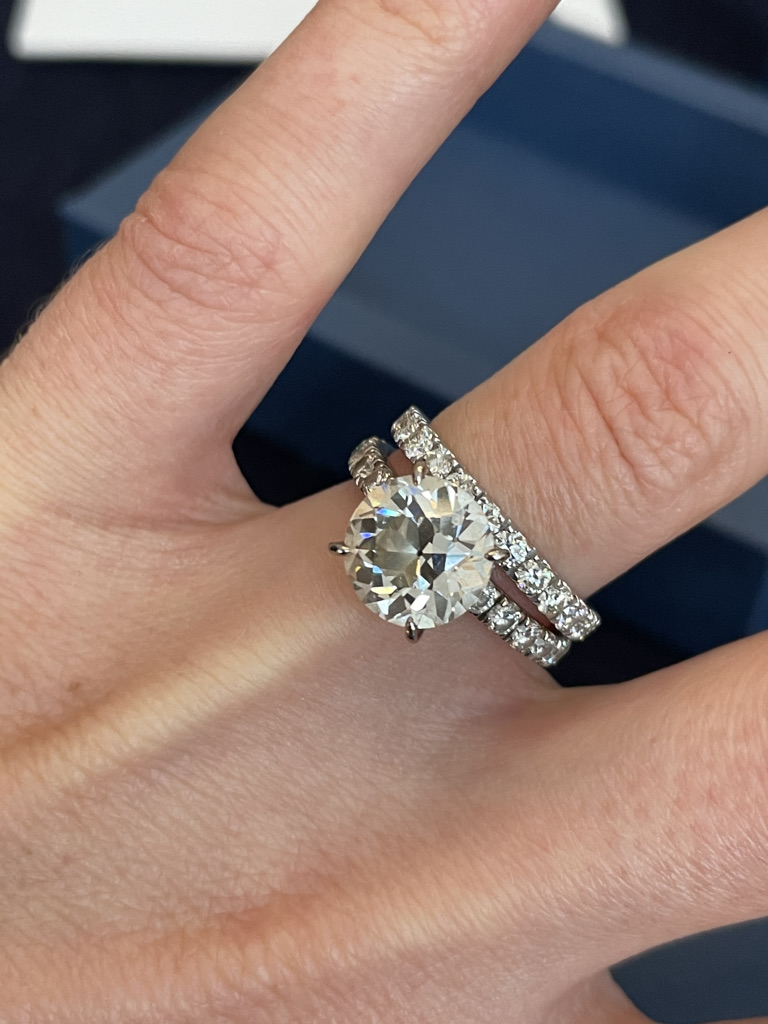
Four ways to stack an engagement ring and a wedding ring. Each shows one of the four points discussed further down.
The most honest answer to the opening question is: today it hardly matters.
You can wear the engagement ring on the left and the wedding ring on the right. You can stack both. You can change hands after the wedding or leave it be. You can take the engagement ring off at work and put it back on in the evening. You can wear it on the other hand because you are right-handed and the stone would otherwise constantly knock against things. That, incidentally, is a far better reason than any tradition.
There is no etiquette in Germany that anyone could hold against you, and if someone does try, it helps to point out that they do it differently in Zurich.
What I do regularly experience in conversations, though: the question about the hand is rarely the real question. It is the question one can ask because it seems to have a clear answer. Behind it there is almost always another one, and hardly anyone asks that one in time.
The question that matters more than the hand
In the vast majority of cases, an engagement ring is not worn alone. At some point a second ring joins it, and then the two spend decades side by side on one finger. That is precisely where it is decided whether the ring remains a piece one wears every day, or one that lies in its box because it did not prove itself in daily life.
Four points I discuss with almost every couple, and which are best settled before the engagement ring, not after:
The height of the setting. A high-set stone looks magnificent in the photograph and catches on your jumper. It also prevents a wedding ring from sitting flush. A gap appears, and many find it bothers them later. A lower setting is less spectacular and gets worn three times as often.
The contour. An engagement ring with a straight underside can be combined with almost any wedding ring. One with a curved band needs a wedding ring that follows that curve. That one then has to be made to order, which is perfectly feasible, but leaves no free choice later.
The metal. Two rings that rub against each other wear unevenly if they differ in hardness. Softer alloys lose out to harder ones. Anyone combining platinum and gold should know which of the two rings will be the thinner one in twenty years.
The hand you work with. If you are right-handed, a ring on the left hand stays beautiful for longer. That is not tradition but materials science, and one of the few genuinely good reasons to decide on a side.
None of these points can be repaired afterwards without opening the ring. All four can be settled beforehand in twenty minutes.
Sometimes the question itself shifts in conversation
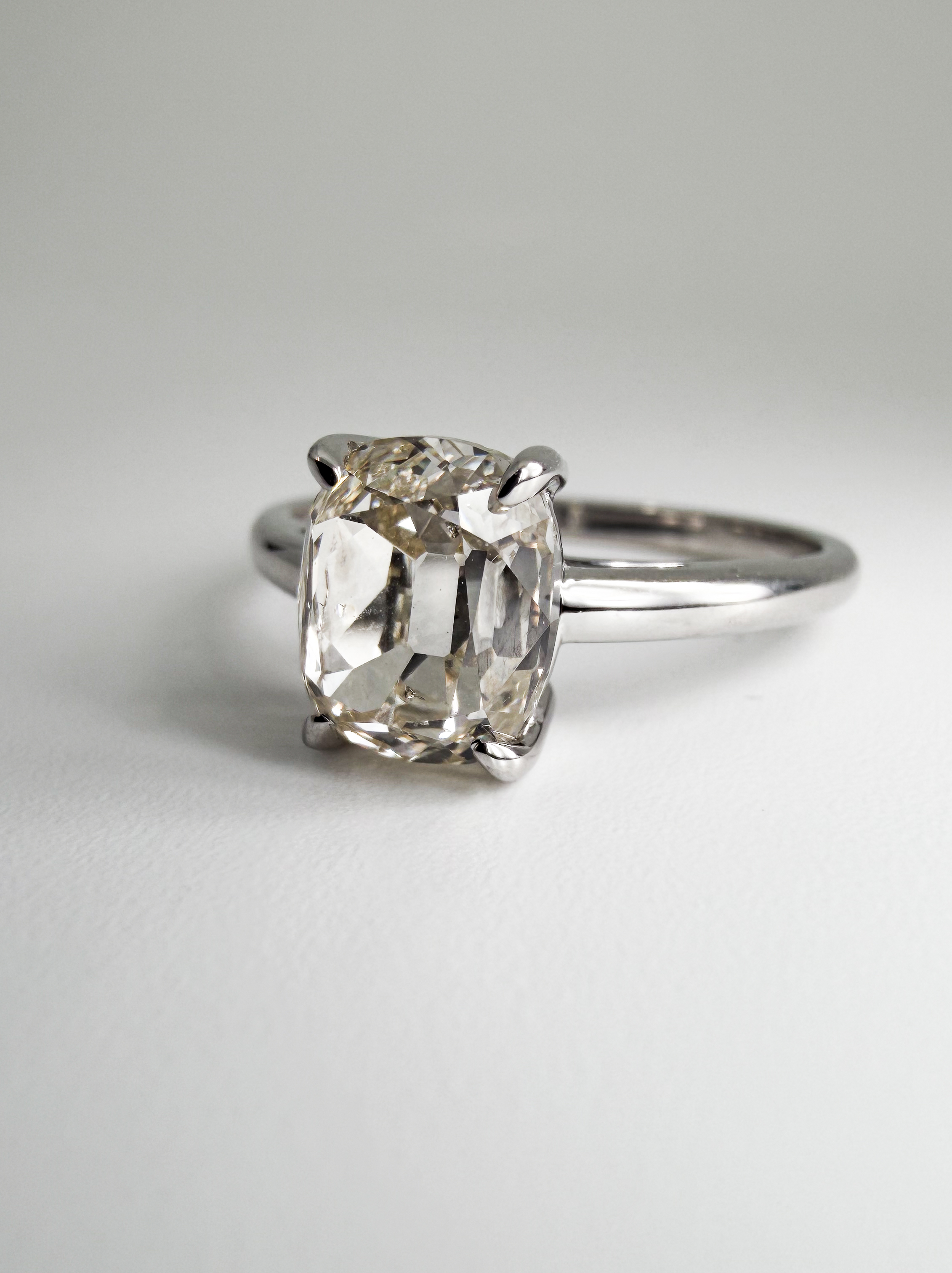
An Old Miner Cut in platinum. The slight warm tint is the rule with antique stones, not the exception.
Some time ago a client sat with me who could not decide: modern brilliant or lab-grown diamond. He had researched both, knew the arguments on both sides and still got no further. That was not down to him. It was because the question, put that way, has no good answer. It forces a choice between two versions of the same idea.
I suggested a third way to him: an antique stone. An Old Miner Cut, cut by hand long before there were machines for it, with all the irregularities that come from that.
It was not the look alone that convinced him. It was that in this one stone two things met which both mattered to him and which until then he had thought irreconcilable: history and sustainability. A stone that has been in circulation for over a hundred years does not need to be newly mined. It is already here.
Added to that was something most people only understand once they see it in daylight. Old cuts almost always have a slight tint, a warm creamy white instead of the cool white of modern goods. Perfectly colourless old cuts exist, they are just considerably rarer. On today's grading scale this tint counts as a downgrade. On the finger, in daylight, it often looks warmer and more alive than any stone of the top colour.
He chose it, and in the end everyone was very happy. Not because he had found the right answer to his opening question, but because in conversation he was given a better question.
More on these stones can be found in The return of the old cuts.
If you still have to decide
If you would like a recommendation and not just a cultural history: take the hand on which you are most likely to wear the ring every day. Everything else follows from that.
If you work a lot with your hands, that is the weaker hand. If you care that the engagement ring and wedding ring will later work together, it is the hand on which both are meant to have room. And if your family's custom means something to you, then it is that hand, not because it would be right, but because that is exactly how meaning comes about.
What you do not need to do: worry about getting it wrong. You cannot get it wrong. At most you can choose a ring that does not suit the life you lead, and that has nothing to do with the hand.
Anyone who would like to read up on the stone first will find a follow-on text here: Why some gemstones are ten times more valuable than others.
If you are at this point right now and notice that the questions become more concrete the longer you think about them: a conversation is a better place for that than a page of search results.
Usually we are further along after an hour than after three weeks of research.
Frequently asked questions
On which hand is the engagement ring worn in Germany?
Traditionally on the ring finger of the left hand. In the classic version it moves to the right hand at the wedding. But there is nothing binding about it.
What happens to the engagement ring after the wedding?
There are four common paths: it moves to the right hand together with the wedding ring, it stays on the left while the wedding ring is worn on the right, it is kept for special occasions, or both rings are stacked on one hand.
Why are rings worn on the ring finger?
The common explanation is the vena amoris, a supposed vein running from the left ring finger to the heart. Anatomically it does not exist. The idea goes back to ancient accounts and was popularised in 1686 by Henry Swinburne's treatise on marriage law.
Is the engagement ring worn differently in other countries?
Yes, considerably, and already just across the border. In Switzerland both rings are mostly worn on the left, so the wedding ring sits differently from Germany. In the USA, the United Kingdom, France and Italy both rings also stay on the left. In Brazil and Chile both partners wear their rings on the right at first and switch at the wedding. In India the left hand was traditionally considered unclean.
Can the engagement ring and wedding ring be worn on one finger?
Yes, this is widespread today. What matters is that the two rings fit each other structurally: setting height, the contour of the band and the hardness of the metal should be matched beforehand.
Is there a wrong hand for the engagement ring?
No. There are regional conventions, but no binding rule. The most practical advice: choose the hand on which the ring can be worn every day.