
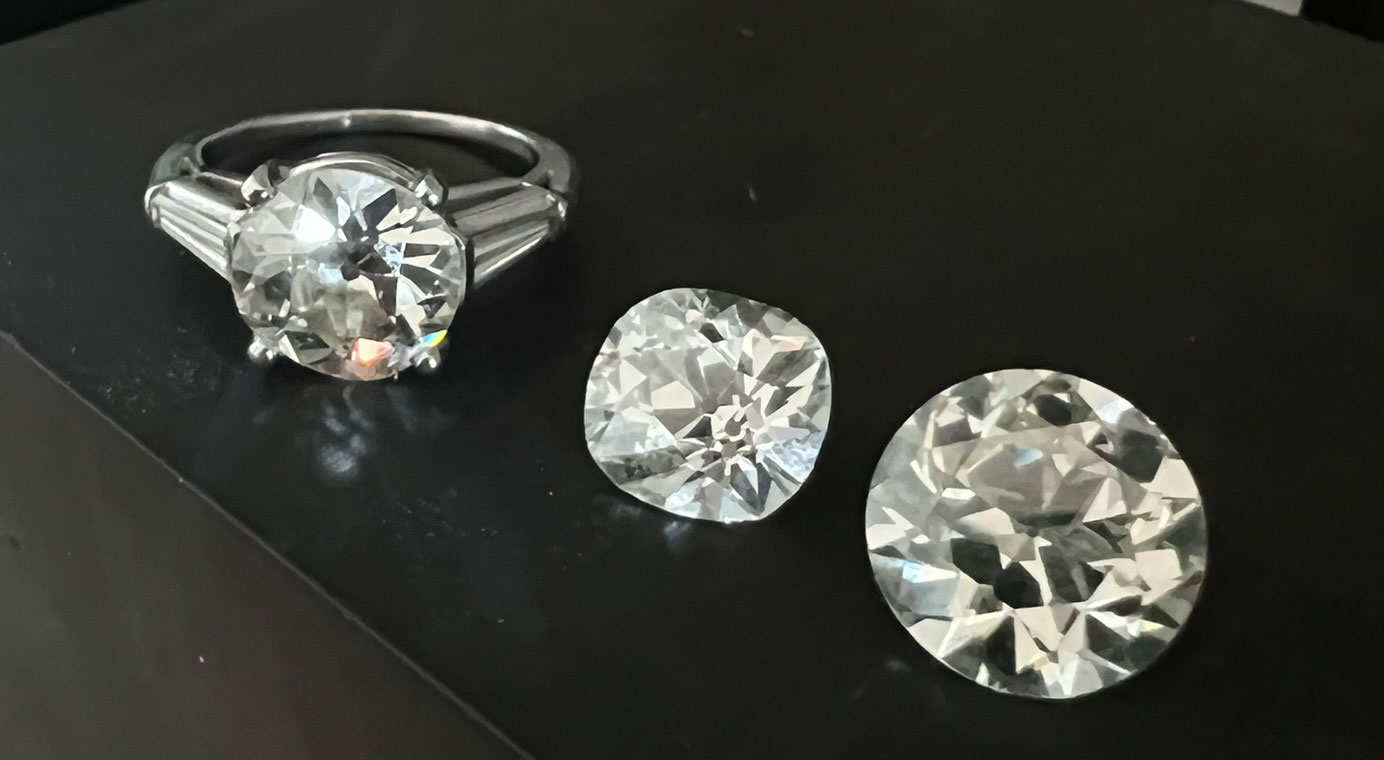
For some years now, something remarkable has been happening in the auction rooms: the oldest diamonds in the room are attracting the youngest bidders. Old Mine Cuts, Old European Cuts, stones that were cut by hand a hundred or more years ago, are finding their way into the engagement rings of people who could have anything modern. This is not nostalgia. Looked at closely, it is the most logical purchasing decision in the entire diamond market.
What an old cut actually is
Until the 1930s, every diamond was cut by hand, by eye, in daylight or by candlelight. The Old Mine Cut, roughly 1700 to 1890, has a cushion-shaped outline because it followed the shape of the rough crystal. The Old European Cut, from about 1890 to 1930, became rounder but kept the old architecture: a high crown, a small table, large, generous facets and frequently an open culet, the little window on the underside through which you can look into the stone.
Then, in 1919, came Marcel Tolkowsky's calculation of the modern brilliant, and with it the machine. Ever since, diamonds have been optimised for maximum light return. Every modern brilliant is excellent at this. And that is precisely the problem: they are all excellent in the same way.
Why they shine differently
The old proportions do something modern stones cannot: they break the light into large, slow flashes rather than fine sparkle. The trade calls it fire; I call it character. At a dinner, in a restaurant, by candlelight, an Old European Cut throws broad flashes of colour across the table where a modern brilliant merely flickers white. Anyone who has once seen the two side by side in half-light understands within seconds what collectors are so fond of.
An Old Minor Cut from my own stock, filmed in daylight. No studio, no tricks.
Why now, of all times
Three reasons are driving the return, and none of them is fashion.
Genuine scarcity. No more old cuts are being made, for a simple reason: the era is over. Worse for the supply, better for the owner: over the decades, old cuts were recut to modern shapes in vast numbers because the trade regarded them as imperfect. Every one of those recuts irretrievably destroyed a historic example. The stock can only shrink.
Individuality rather than a logo. No two old cuts are alike, because each was cut by a different hand. Anyone who today deliberately wants no brand name on the box but a stone with its own signature ends up here almost inevitably.
The most honest sustainability. A stone that has been above ground for a hundred years causes no new mining, no new energy consumption, no new transport chains. Anyone who takes the debate about the environmental footprint of diamonds seriously will find the most elegant answer in the old cut.
The three most important old cuts
Old Mine Cut, cushion-shaped, high crown, the oldest form. Often the most coveted among collectors.
Old European Cut, round outline, the link to the modern era. The most elegant choice for engagement rings.
Transitional cuts, the brief phase around 1930 in which handwork and new proportions came together. Connoisseur territory.
Three cuts, three characters: profile, top view and what remains of it on the hand.
What to look for when buying
First: the certificate. Even a hundred-year-old stone deserves independent examination; at GIA, old cuts are usually recorded as "Circular Brilliant" with corresponding notes. Second: the original condition. An "improved" old cut, one whose culet someone has closed or whose girdle has been repolished, has already lost its historic value. Third: read the proportions as character, not as flaws. A slightly asymmetrical outline, a generous culet, that is the signature of the cutter who sat at this stone four generations ago.
And fourth: the mounting. An old cut in an off-the-shelf setting looks like an oil painting in a plastic frame. The high crown needs room, and the light has to reach the stone from the side. One of my favourite commissions of recent times, an Old European Cut between baguettes in platinum, I built in three days and brought to Rome in person. The stone was in a hurry to ask its question.
My view as a dealer
I actively buy old cuts, at auction, from estates, in the trade, and I admit: partly out of self-interest. They are among the most exciting things the diamond market has to offer at the moment, because the arithmetic is so rarely this clear: growing demand, a supply that can only shrink, and a price level that in many places has not yet priced in the historic rarity. My family cut some of these stones when they were new. There is a certain poetry in my gathering them up again today.
If you are thinking about an old cut, for an engagement ring, an heirloom or simply because you once saw one in candlelight: I would be glad to show you both worlds side by side.
Then you decide.