
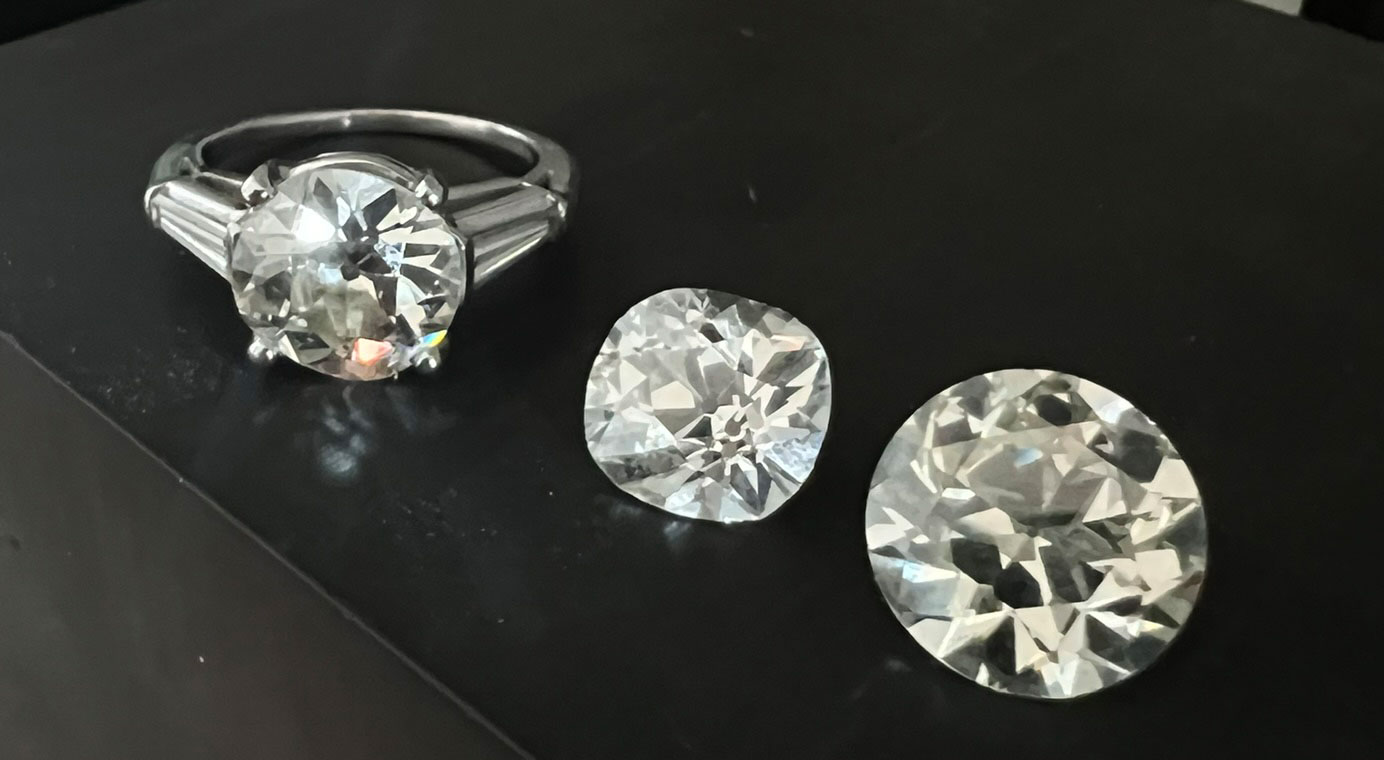
The question is not new, but it is becoming more pressing: which diamond is the right one? The natural stone, whose formation took billions of years? The antique one, which already carries history and shines in a unique old cut? Or the lab-grown one, morally clean and ecologically responsible?
Each of the three options has its merits. But not all of them are worth the same.
Natural diamonds: the magic of the earth
A natural diamond is the product of extreme conditions. Carbon, formed in the earth's crust under pressure of over 5,000 degrees Celsius and pressures of 50 kilobar. The result: a stone whose optical and physical properties no laboratory can perfectly replicate.
Natural diamonds were formed millions to billions of years ago. They were carried to the surface by volcanic events. Each one is unique, a record of time, earth and chance.
For investment, natural diamonds are the solid choice. Over decades they show stable to rising value, particularly in top qualities (D-F colour, VS1-SI1 clarity, well cut). There is an established international market, standards (GIA, DCLA) and liquidity.
What makes natural diamonds valuable?
Their rarity is real. On average there is roughly one diamond per 1 million tonnes of rock. Good qualities are considerably rarer still. This objective rarity creates economic stability.
Antique diamonds: the soul of a stone
When a diamond is more than 50 years old and comes from a historical period (Georgian, Victorian, Edwardian, Art Deco), it becomes something special: a witness to its time, with its own name, its own character, its own story.
Antique diamonds differ from modern stones above all in their cuts. A Victorian diamond was often worked in a brilliant-style cut that differs from the modern brilliant cut. These old cuts, among them the Old European Cut and the Old Mine Cut, have a warmth, a glow, that modern cuts do not.
But it is not only about the look. An antique diamond that has been worn in a wedding ring setting for 80 years has a presence that newly bought stones do not. It has lived.
For investors this is an advantage: emotional attachment leads to long-term holding. People do not sell heirlooms when prices fluctuate. That makes antique diamonds stable, long-term assets.
On top of that, there is an aesthetic premium. An outstanding example of an Art Deco diamond can be worth 20-30 per cent more than its pure caratage would suggest.
Lab-grown diamonds: the modern solution
In 2003 the first commercial lab-grown diamonds (LGD, also known as CVD or HPHT) came onto the market. Chemically they are identical to natural diamonds. They are produced by means of High Pressure High Temperature (HPHT) or Chemical Vapor Deposition (CVD) in two to three weeks.
The arguments are tempting: no mining, no child labour, no ravaged landscapes. Climate ethics in diamond form. Lab-grown diamonds are also considerably cheaper, often 40-50 per cent below natural stones of comparable quality.
But as an investment, lab-grown diamonds are problematic. Here are the reasons:
The LGD problem: why they are not a store of value
1. Rising production. As technology improves, production costs fall. Output is growing exponentially. That pushes prices down.
2. No established secondary market. It is difficult to resell a used LGD. Most buyers want new stones.
3. No lasting value. An LGD bought in 2010 for 1,000 euros may today be worth 300 euros.
4. The psychological factor. LGD feel artificial. That may be morally wrong, but economically it is real: natural diamonds hold their value because people perceive them as genuine stores of value.
Comparison: the three types of diamond
| Criterion | Natural | Antique | Lab-grown |
|---|---|---|---|
| Investment potential | High | Very high | Low to negative |
| Emotional value | Medium | Very high | Low |
| Ethical questions | Depends on context | None (recycled) | Low |
| Market liquidity | High | Medium to high | Low |
| Price stability | Stable | Stable to rising | Downward trend |
| Wearing experience | Classic | Timeless | Flawless |
The answer: why antique diamonds are the best choice
Looking at the three options, it quickly becomes clear: antique diamonds unite all the advantages and minimise the weaknesses.
They are natural, and therefore hold their value. They are emotionally valuable, and therefore an investment one loves. They carry a story, and therefore more than economic worth. And they are ethically sound, because they are not newly mined but recycled.
An antique diamond is a threefold store of value: financial, emotional and temporal. It grows more valuable not because the markets decree it, but because its rarity becomes ever more real, and because the people who wear it become part of its story.
Are you interested in antique diamonds, or would you like a natural stone with genuine provenance and a story worth telling? Then let us talk about it.
Not as a sale. As a conversation between connoisseurs.