
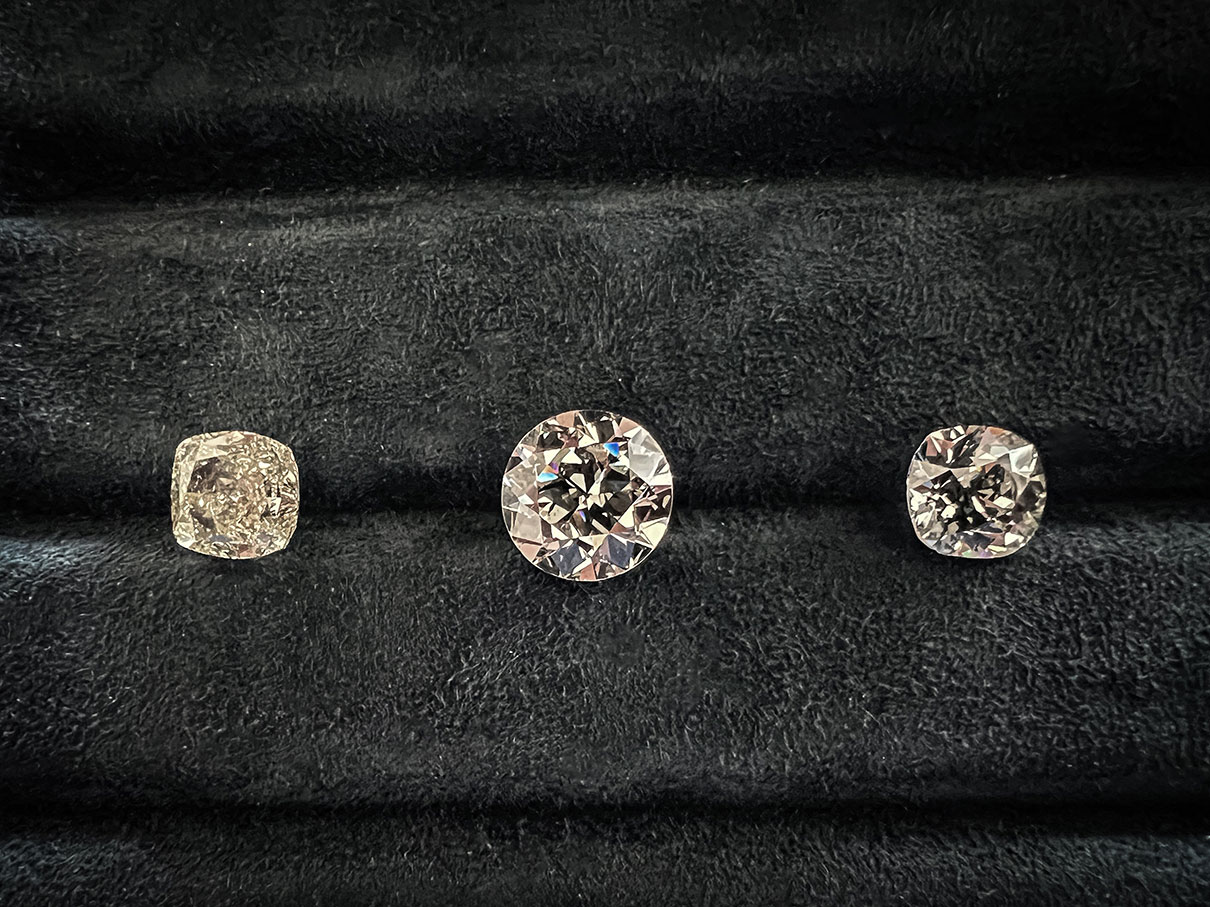
Over the past ten years, a new battle cry has swept through the marketing of the jewellery industry: lab-grown diamonds are identical to natural diamonds, cheaper, more ethical, more sustainable. A marketing triumph of superlatives. And an untruth that I must address precisely because I am a jeweller.
The supposed identity
First, the facts. A lab-grown diamond and a natural diamond do indeed share the same crystal structure; both are carbon in cubic form. That is rather like saying a Rolex and a perfectly made imitation are identical because both contain a quartz movement.
With the simplest of testing devices, a diamond tester that works in seconds, anyone can detect the differences. Lab-grown diamonds have characteristic growth patterns, tiny differences in structure that reveal: this was made. In a factory. In a matter of weeks.
The truth about the price
The price is the most telling feature of all. A lab-grown diamond costs roughly 40 to 60 per cent less than a natural stone of comparable size and quality. That is not a sign of "democratisation"; it is the hallmark of mass production.
The core problem
In a factory, you can produce hundreds or thousands of diamonds every week. That is not rare. That is abundance. And abundance is the opposite of what makes luxury.
When you buy a lab-grown diamond for €2,000, you are paying for: electricity. A few weeks of time. And a marketing promise. When you buy a natural diamond for €5,000, you are paying for: rarity that no algorithm can replicate. Three billion years of the earth's history. And a store of value.
The green myth
The sustainability narrative is the most successful selling point of the lab-grown diamond industry. And the most persistent misconception. Several independent studies have shown that producing a lab-grown diamond causes between 180 and 220 kilograms of CO₂ per carat, in some cases more than natural mining from responsible sources.
The energy comes from the grid. The factory runs 24/7. A natural diamond was created millions of years ago. The CO₂ of extraction is a one-off. And with larger, certified stones from responsible sources (Canada, Botswana), the ecological balance is clearly in their favour.
The value that disappears
The most important point goes unsaid: value over time. A natural diamond of high quality is a store of value. A lab-grown diamond is not. There is no secondary market. There are no auctions. There is no price stability.
Why would a buyer pay €5,000 for a lab-grown diamond if the same stone will be worth €500 in five years? Exactly. They do not. That is why the market for lab-grown diamonds is a market of artificially lowered prices, not of genuine demand.
What luxury really means
I have been a jeweller for generations. My family has traded in gemstones since 1837. I know the difference between a product and an asset, between a consumer good and an heirloom.
A real diamond is rare. There is a limit to how many can be recovered each year. That creates value.
A real diamond has history. It lay in the ground while continents drifted. While cultures rose and fell. That is not sentimental; that is economic.
A real diamond can be passed on. With the certainty that your child and your grandchild will know: this is real. This is valuable. This endures.
A lab-grown diamond? That is a consumer product. With the longevity of fashion. With the emotional depth of a mass-produced article. With the value stability of a smartphone.
If you are considering a diamond for an engagement ring or an heirloom, speak to someone who has no interest in selling you the cheapest option.
Speak to a jeweller.